


Long before wellness trends had names, coastal communities and mountain cultures were already relying on Sea Moss and Shilajit. Both have stuck around for centuries, and both are now getting fresh attention as people look past the marketing hype and ask what these substances actually offer.
They’re often lumped together as “superfoods,” but that label undersells them. Sea Moss and Shilajit work through different mechanisms and support different systems in the body. Used together, they cover more ground than either one does alone.
What Sea Moss Brings to the Table
Sea Moss grows on rocky stretches of the Atlantic coast, in conditions that would kill most plant life. To survive there, it has packed itself with an unusually dense mix of minerals — reportedly 92 of the 102 minerals the human body needs.
That’s a striking number. Most supplements on store shelves offer a handful of isolated nutrients — maybe five, maybe ten. Sea Moss instead delivers something closer to a full mineral spectrum: iron for carrying oxygen, iodine for thyroid support, potassium for cell signaling, magnesium for muscles and nerves.
People who use it regularly often mention better digestion. The natural fiber in Sea Moss appears to support gut function, and the broad mineral content seems to back up digestive processes more generally. Energy also tends to shift over time — not the jittery spike of caffeine, but a steadier baseline that many attribute to simply having more of what the body needs on hand.
Why Shilajit Is Different
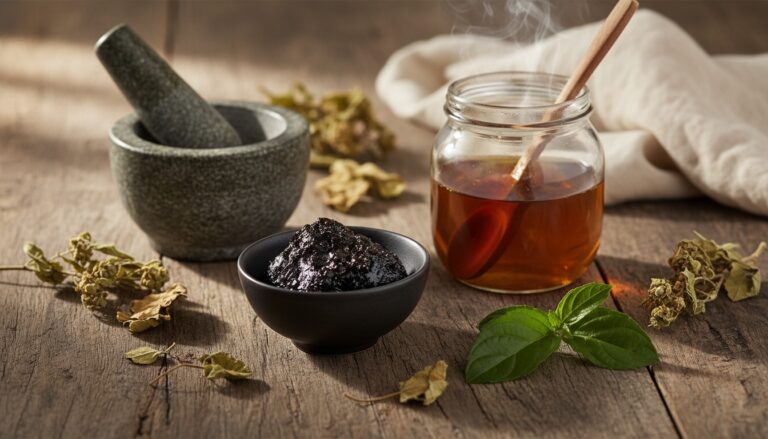
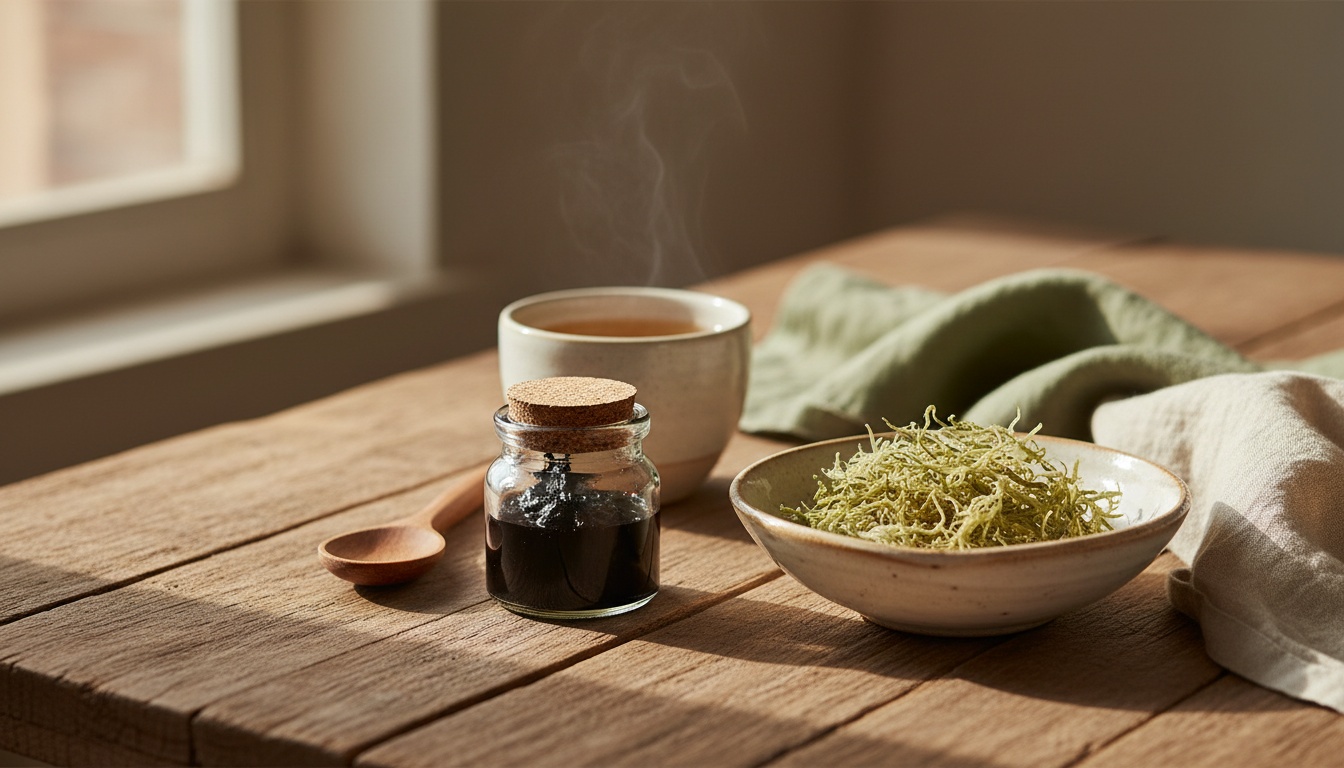
Shilajit doesn’t come from a single plant. It forms over long stretches of time, high in mountain ranges, as plant material breaks down and compresses into a dark, tar-like substance loaded with fulvic acid and more than 80 trace minerals. That slow, layered process concentrates nutrients in a way no single herb can match.
Fulvic acid is the real story here. It functions almost like a delivery system, helping the body take in and actually use nutrients rather than letting them pass through unused.
There’s also growing interest in Shilajit’s potential for brain support — some research points to fulvic acid interfering with tau protein clumping, which has opened new questions for cognitive health studies. Anecdotally, users describe sharper focus and steadier mental energy, along with a more even, sustained physical energy that doesn’t come with the crash typical of stimulants.
The Case for Taking Them Together
Individually, both botanicals do useful work. Combined, they solve a problem neither can fix alone.
Sea Moss supplies the raw minerals. Shilajit supplies the fulvic acid that helps the body absorb them. That pairing matters because mineral absorption is genuinely difficult — the digestive system often struggles to break down minerals in their raw form, and a lot of what you take in from typical supplements simply passes through unused.
Fulvic acid essentially escorts those minerals across cell membranes, so you get more benefit from the same dose. People who combine the two often notice a different kind of energy than either supplement gives on its own — steadier, and tied to actual mineral uptake rather than a temporary boost.
How to Use Them
A few practical habits make a real difference in how much benefit you get.
Timing: Take both on an empty stomach, roughly 30 minutes before eating. Food can interfere with absorption, so this window matters.
Dosage: Start conservatively — around 1–2 grams of Sea Moss and 300–500 mg of Shilajit daily. After a few weeks of consistent use, adjust based on how your body responds.
Consistency: These aren’t fast-acting supplements. Daily use over 4–6 weeks gives your body time to build up mineral reserves and show real change.
Format: Sea Moss comes as gel, powder, or capsules. Shilajit can be dissolved in warm water or taken as a raw resin. Many people mix both into room-temperature water. If the taste is a sticking point, capsule forms help. Some people also explore other botanical formats for convenience — kratom chocolate bars or kratom vapes, for instance — though these are separate products with their own distinct effects and considerations.
Hydration: Since better mineral absorption puts more demand on cellular processes, drink enough water throughout the day.
Buying Quality Products
The Sea Moss market has exploded in recent years — one estimate put it at $2.18 billion in 2024 — and that growth has brought a flood of lower-quality products along with it.
A few things to check before buying:
- Sourcing: Wild-harvested Sea Moss from clean Atlantic waters tends to carry a denser mineral profile than pool-grown or farmed versions.
- Texture: Real Shilajit should be sticky at room temperature and dissolve fully in warm water. If what you’re holding is a hard tablet or dry powder, ask how it was processed.
- Testing: Reputable suppliers run third-party tests for heavy metals, microbial contamination, and active compound levels — especially important given that these botanicals come from ocean and mountain environments where contamination risk is real.
- Ingredients: Skip products padded with fillers, artificial coloring, or unnecessary additives. Less processing generally means more of the original nutritional value survives.
What You Might Notice, and When
Changes tend to show up in stages rather than all at once.
Digestive improvements are usually the first thing people notice, often within the first week or two, thanks to the fiber and mineral content in Sea Moss.
Energy shifts tend to build over several weeks — less about a sudden lift and more about avoiding the usual afternoon slump.
Mental clarity is often the last thing to show up, typically somewhere around the 3-4 week mark, with people reporting better focus during demanding tasks.
Everyone’s starting point is different. Diet, baseline mineral levels, and overall health all affect how quickly benefits appear — some people notice changes within days, others need a month or more. Sleep can also improve gradually, likely tied to magnesium and other minerals known to support relaxation.
Bottom Line
Sea Moss and Shilajit take a different approach than most supplements. Instead of targeting one symptom with one isolated compound, they supply broad nutritional support and let the body do the rest.
The pairing works specifically because it solves two problems at once — Sea Moss brings the minerals, Shilajit helps the body actually absorb them. That combination builds a foundation for steady, longer-term wellness rather than a quick fix.
Choosing well-sourced products, using them consistently, and keeping expectations realistic makes the difference between wasted money and real benefit. Done right, these two botanicals offer a straightforward, natural way to support energy, digestion, and overall health through solid mineral nutrition.
Frequently Asked Questions
Can beginners take Sea Moss and Shilajit together?
Yes — just start small. Around 1 gram of Sea Moss and 300 mg of Shilajit daily is a reasonable starting point.
How long before I notice anything?
Digestive changes often show up within the first week. Energy and mental clarity benefits usually take 3-4 weeks of steady use.
When’s the best time to take them?
On an empty stomach, about 30 minutes before your first meal.
Can I combine these with other supplements?
Generally yes, but space them out by at least two hours. Fulvic acid can boost absorption of other nutrients too.
How do I spot a quality product?
Look for third-party lab testing, wild-harvested Sea Moss from the Atlantic, and Shilajit that stays sticky at room temperature.
Should I take breaks from these?
Many people use them daily for 8-12 weeks, then pause for two weeks to gauge benefits and avoid building tolerance.
What if I don’t like the taste?
Mix both into room-temperature water with a splash of juice, or switch to capsules if your supplier offers them.
Are there other botanical options worth knowing about?
Yes — the space includes things like kratom chocolate bars and kratom vapes for people who want different formats. These are distinct products, though, with their own properties and considerations separate from Sea Moss and Shilajit.