



More people are buying kratom than ever before—American use has grown roughly tenfold since 2021. With that growth has come a wave of new local sellers, from smoke shops to specialty stores. But easier access doesn’t mean easier decisions. The gap between a careful vendor and a careless one can be significant, and it’s worth knowing what separates the two before you buy.
Start With the Law, Not the Product
Before you set foot in a store, find out whether kratom is actually legal where you live.
As of 2025, kratom remains legal in 44 states. Six states ban it outright: Alabama, Arkansas, Indiana, Rhode Island, Vermont, and Wisconsin. That’s the easy part. The harder part is that some cities and counties impose their own bans even in states where kratom is otherwise legal. San Diego banned it back in 2016. So did Sarasota County, Florida, and Union County, Mississippi—despite their states permitting sales. Many residents in these areas have no idea a local ban exists.
The rules are also changing fast. Thirteen states now have Kratom Consumer Protection Acts (KCPAs), which regulate the product rather than outlaw it. South Carolina’s version became law in May 2025, and Mississippi, Oklahoma, Florida, and Texas all pushed similar measures through their legislatures this year.
Texas stands out. Its new law, effective September 2025, caps 7-hydroxymitragynine at 0.1% of the alkaloid content and requires accredited lab testing for contaminants and potency—among the toughest standards in the country.
Bottom line: check your state, county, and city rules before buying. What was fine last month might not be fine now.
Where People Actually Buy Kratom Locally
Once you’ve confirmed it’s legal, you’ll find a handful of common outlets.
Smoke shops and vape stores are the most typical source. Sales through mainstream retail channels topped $441 million for the year ending October 2024, up nearly 22% from the previous year—and a lot of that volume runs through shops like these. The upside is convenience: walk in, buy, walk out. The downside is that kratom is usually a side item for these stores. Selection tends to be thin, prices run higher, and the staff rarely has deep product knowledge.
Health food and supplement stores sometimes carry kratom, especially in areas with a strong wellness retail scene. Quality control here is often better than at a general smoke shop, though the strain selection is usually limited.
Dedicated kratom retailers with a physical storefront are the best combination of convenience and expertise, but they’re not common. If you have one nearby, it’s usually your strongest local option.
Gas stations and convenience stores deserve the most caution. One independent lab analysis of kratom products bought from Chicago-area retailers found that every raw leaf sample tested contained concerning levels of toxic metals. Products sitting on a gas station shelf for months, with no visible testing behind them, are a real risk.
What Separates a Good Vendor From a Risky One
Seeing kratom on a shelf isn’t the same as it being safe to buy. Here’s what to check.
Lab results. A trustworthy vendor can show you batch-specific testing for heavy metals (lead, mercury, arsenic), pathogens like E. coli and Salmonella, and pesticides. This matters more than people realize: FDA testing of 30 kratom products found that all but two carried lead levels exceeding safe daily oral exposure limits. Separate 2024 research estimated that at a 25-gram daily dose, over 70% of products tested would exceed safe lead exposure limits. Ask to see the lab results before you buy. If the retailer can’t produce them, or brushes off the question, go elsewhere.
GMP certification. This signals the manufacturer follows Good Manufacturing Practices verified by a third-party audit. About 87% of vendors now participate in the American Kratom Association’s GMP program, which requires annual recertification. You can check a manufacturer’s status directly on the AKA website.
Clear labeling. Look for ingredient lists, alkaloid content where available, batch numbers, expiration dates, and manufacturer details. Vague or missing labels are a warning sign.
Knowledgeable staff. If the person behind the counter can’t explain the difference between red and green vein kratom, or has no idea where the product comes from, that store probably isn’t treating kratom quality as a priority.
Reasonable pricing. Testing and proper sourcing cost money. If a price looks unusually low compared to everyone else, assume something was cut to get there.
Questions Worth Asking Before You Buy
Don’t hesitate to ask. A good vendor expects it.
- “Do you have lab results for this batch?” — the single most telling question you can ask.
- “Is this from an AKA GMP-certified manufacturer?” — confirms the facility meets industry standards.
- “Where does your kratom come from?” — Indonesia supplies roughly 95% of the world’s kratom, and a serious vendor should know their supply chain.
- “How fresh is this?” — kratom loses potency over time, and shelf-worn product isn’t doing you any favors.
- “What’s your return policy?” — a vendor confident in their product usually stands behind it.
Warning Signs to Walk Away From
A few red flags should end the conversation immediately:
- Claims that kratom treats, cures, or prevents a medical condition. These claims are illegal, and any vendor making them either doesn’t know the rules or doesn’t care.
- No lab testing, or testing claims with nothing to back them up.
- Defensiveness or dismissiveness when you ask questions about quality.
- Missing or incomplete labeling.
- Prices dramatically lower than everywhere else.
- High-pressure sales tactics or “limited time” urgency.
Local Shopping vs. Buying Online
Buying nearby means no shipping wait and a chance to look at the product in person. But online specialty retailers often have real advantages: direct relationships with Indonesian suppliers, wider selection, lower overhead (and often lower prices), and detailed product and testing information posted publicly.
Many regular kratom buyers use both — grabbing something locally when they need it right away, but ordering online for their regular supply, where selection and value matter more than speed. If your local options don’t meet basic quality standards, it’s worth waiting a few extra days for something you can trust.
Knowing What You’re Actually Buying
Kratom comes in a few common forms, and it helps to know the differences.
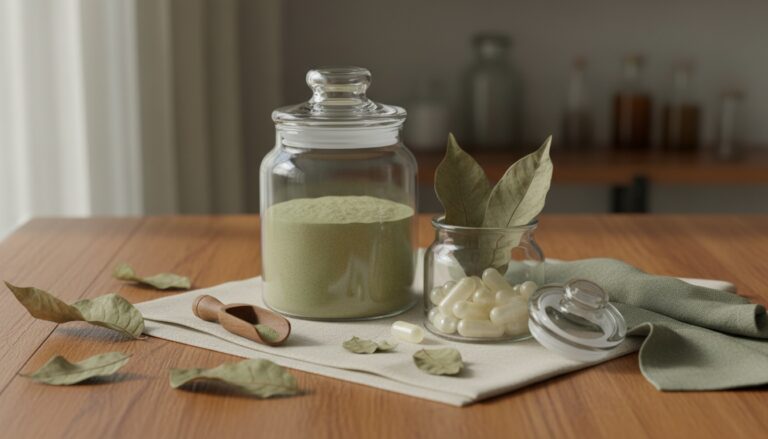
- Powder is the most popular and affordable format, and it lets you adjust your serving size precisely.
- Capsules cost more but skip the taste and add convenience.
- Extracts are concentrated and more potent — the extract market alone was valued at $171 million in 2024, on track to grow substantially by 2031 — but they demand more caution with serving size.
- Teas and edibles, including gummies, offer a more approachable experience for people who don’t like the taste of raw kratom.
Vein color also plays a role. Red vein is generally linked to relaxation, green to a more balanced effect, and white to energy and focus. Origin matters too — Bali, Maeng Da, and Borneo strains each have their own reputation. Since everyone reacts differently, start small and try a sample size before committing to a large quantity.
Buying With Confidence
The checklist is simple, even if the research takes a little time:
- Confirm kratom is legal where you live — state, county, and city.
- Find local vendors and evaluate their testing and certification.
- Ask direct questions and watch for red flags.
- Choose lab-tested, GMP-certified products.
- Start small until you know what works for you.
The market keeps growing — U.S. sales approached $2 billion in 2024, with global projections reaching close to $8 billion by 2032 — and regulation is tightening alongside it. Buying from vendors who prioritize testing and transparency, rather than the lowest price, is a small decision that adds up. It protects you, and it pushes the whole market toward higher standards.
Closing Thoughts
Buying kratom nearby can be simple and safe, but it takes a little diligence. Know your local laws, ask pointed questions, check for lab results and certification, and don’t let a low price talk you out of doing your homework. The extra ten minutes of research is a small price for knowing exactly what you’re putting in your body.
Frequently Asked Questions
Is it legal to buy kratom in my area?
Kratom is legal in 44 states as of 2025. Alabama, Arkansas, Indiana, Rhode Island, Vermont, and Wisconsin ban it statewide, and some cities and counties in otherwise legal states have their own bans. Check local rules before buying.
Is gas station kratom safe?
Treat it with extra caution. Independent testing has repeatedly found convenience store products with concerning levels of toxic metals and no visible quality control. If you buy from a gas station, ask whether the product comes from a GMP-certified manufacturer and has current lab results.
How much should kratom cost locally?
It varies, but local shops usually charge more than online vendors due to overhead. Powder tends to be cheaper per gram than capsules or extracts. Be skeptical of prices well below the norm.
What’s the difference between red, green, and white vein kratom?
The vein color reflects the leaf’s condition at harvest and influences its effects. Red is typically associated with relaxation, green with balance, and white with energy and focus — though individual results vary.
Should I buy locally or online?
Both have a place. Local buying gives you immediate access and lets you inspect the product first. Online vendors usually offer more selection, better prices, and more transparency about testing. Many people do both, depending on the situation — but quality standards shouldn’t change either way.
How do I verify a vendor’s claims?
Ask for batch-specific lab results covering heavy metals, pathogens, and pesticides. Check GMP certification on the American Kratom Association’s website. Look for clear labeling with ingredients and batch numbers. A vendor with nothing to hide will show you this without hesitation.