



There’s no FDA-approved dosage chart for kratom, so anyone looking for official guidance won’t find one. What does exist is a decent stack of survey data, pharmacokinetic studies, and years of community experience — and together they point to some pretty consistent patterns. Most people land in the 2–5g range with plain leaf powder, with lower doses (under 3g) tending toward stimulant effects and higher doses (above 5g) shifting toward sedation and pain relief.
The one rule that matters more than any other: start lower than you think you need, and raise the dose gradually across sessions — never within a single sitting.
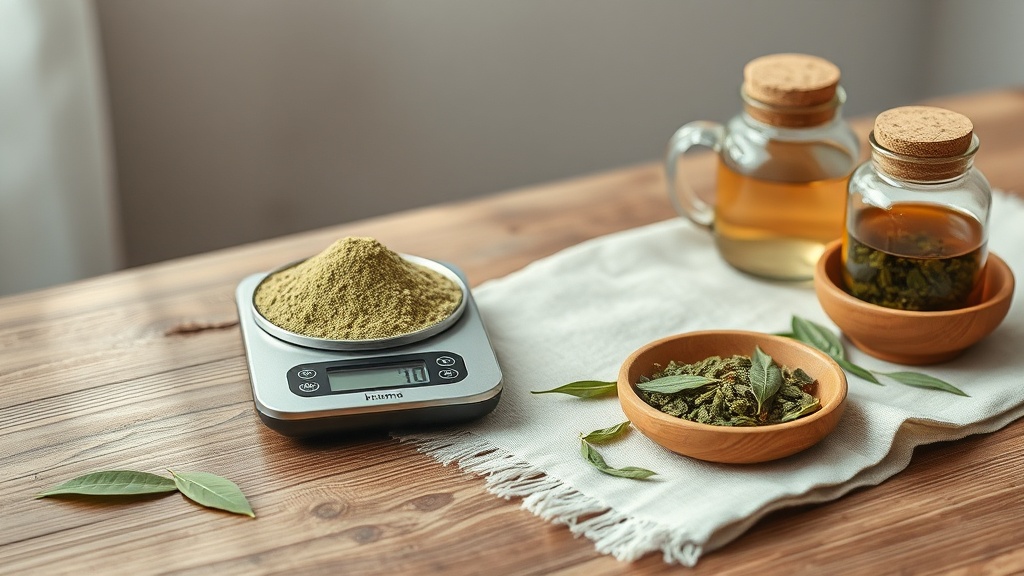
If you’re new to this, start at 1.5–2g and give it 45 to 60 minutes before deciding whether it worked. Research on experienced regular users puts the median effective dose closer to 3–5g (Grundmann 2017). Keep in mind that extracts are much stronger per gram than plain leaf, so never dose them the same way. And always weigh your kratom on a digital scale — a spoon won’t cut it. If you find yourself needing 7–8g just to feel normal, that’s usually a tolerance issue, not a sign you need a bigger dose.
What Is the Right Dose by Experience Level?
Your experience with kratom — meaning how much tolerance you’ve built up — matters more for figuring out your dose than your body weight or almost anything else. Grundmann (2017) surveyed over 8,000 kratom users in the U.S. and found a median single dose around 4–5g of powder among regular users, though it varied quite a bit depending on history and purpose. [1] Smith et al. (2022) backed this up in a separate study, showing the same dose-dependent pattern: stimulation at lower amounts, sedation and pain relief once you cross the 5g mark. [2]
| Experience Level | Starting Dose | Typical Range | Dominant Effects |
|---|---|---|---|
| First-time / Beginner | 1.5 g | 1.5–2.5 g | Mild alertness, subtle mood lift; threshold effects only |
| Low Tolerance | 2 g | 2–3.5 g | Clear stimulant effects; mood elevation; manageable duration |
| Regular User | 3 g | 3–5 g | Full effects — stimulant (white/green) or relaxation (red); 4–6 hr window |
| High Tolerance | 5 g | 5–7 g | Opioid-dominant: sedation, analgesia; higher side effect risk |
Grundmann’s survey also found that adverse effects clustered around the higher doses — another reason to stick with the smallest amount that gets the job done, regardless of your experience level. [1]
Here’s the rule for your first session: take your dose, then wait out the full onset window — 45 minutes for powder on an empty stomach, up to an hour for capsules. Don’t re-dose just because things feel mild during the 45-minute-to-90-minute rising phase. If you do, the second dose stacks on top of the first right as it peaks, and you end up with roughly double what you intended. This mistake accounts for most of the bad experiences new users report.
How Does Kratom Form Affect Dosing?
Not all kratom products are equal gram for gram. Extracts pack a much higher concentration of alkaloids, so a gram of extract delivers far more than a gram of plain leaf. Misunderstanding this is probably the single most dangerous mistake people make with kratom, and it’s behind most extract-related bad experiences.
| Format | Beginner Starting Dose | Regular User Range | Notes |
|---|---|---|---|
| Powder | 1.5–2 g | 3–5 g | Weigh on a scale. A level teaspoon ≈ 2–2.5g but varies by grind — never rely on volume. |
| Capsules (0.5g each) | 3–4 capsules (1.5–2g) | 6–10 capsules (3–5g) | Onset 30–60 min due to capsule dissolution. Wait the full hour before assessing. |
| Kratom Tea | 2–3 g (leaf equivalent) | 3–6 g (leaf equivalent) | Alkaloid extraction ~70–85% of raw powder. Slightly higher gram weight may be needed for equivalent effect. |
| Extracts | ½ the label minimum | Follow COA mitragynine mg | Not gram-equivalent to plain leaf. A 10x extract at 0.5g delivers ~5g equivalent alkaloid load. Do NOT start with extracts. |
| Shots | ½ bottle | ½–1 bottle | Liquid extract — fast onset (10–25 min). Check the COA for mitragynine mg per bottle to compare to your powder dose. |
| Gummies | 1 gummy | 1–2 gummies | Pre-dosed extract edibles. Follow package serving; individual gummies vary 10–50mg mitragynine each. |
Onset also varies by format in ways worth knowing. Trakulsrichai and colleagues established the baseline pharmacokinetics for oral mitragynine, finding peak plasma levels around 1.5 hours after standard powder — capsules take longer because the shell has to dissolve first. [3] The only reliable way to compare doses across different formats is by milligrams of mitragynine, not grams of product. A certificate of analysis (COA) that lists mitragynine percentage or mg per unit is what makes that comparison possible. Without one, you’re guessing. Our Kratom COA Guide walks through how to read a lab report and find that number.
How Does Vein Color Affect Dosing?
Vein color changes how strongly you feel a given dose — not because one color is inherently “stronger” than another, but because different alkaloid ratios shift where specific effects show up along the dose curve.
- Red vein tends to bring on relaxation and pain relief at somewhat lower doses than green or white. Experienced users often describe reds as feeling “heavier” gram for gram. If you’re starting with red, stay toward the low end of your bracket — 1–2g for beginners, 3–4g for regular users.
- Green vein offers the most balanced profile: stimulation at low doses, relaxation at higher ones. It’s generally the most forgiving strain to start with, and the dose ranges in the table above apply well here.
- White vein leans stimulant. Some users need a bit more white vein than red to get relaxing effects, since the stimulating properties seem to mask the sedative ones at the same weight. For a stimulant effect, 2–3g of white is usually enough — no need to go higher.
- Yellow/Gold varieties are typically processed differently, and their alkaloid profile varies more than a standard vein color would suggest. The processing method matters more than the original vein here, so start low and adjust.
Treat any new strain — even one within a vein color you already know — as an unknown product that needs fresh calibration. Alkaloid content varies from batch to batch and vendor to vendor; Smith et al. (2022) flagged this variation as a major complicating factor in dose-response research. [2] A good rule of thumb: start 20–25% below your usual dose when trying a new strain or vendor.
What Factors Affect How Much You Need?
- Mitragynine percentage — This is the variable most people overlook. A 4g dose of powder at 1.2% mitragynine delivers about 48mg of the alkaloid; the same 4g at 1.7% delivers 68mg — a 42% difference in actual dose. That’s why the same gram amount can feel completely different from one vendor to the next. A COA-verified percentage is really the only objective way to compare products.
- Stomach contents — Taking kratom on an empty stomach (two-plus hours since eating) speeds up onset to 15–30 minutes and raises peak plasma levels. A heavy meal beforehand can cut peak concentration substantially — a 40–60% reduction isn’t out of the question. A light snack tends to strike the best balance between speed and avoiding nausea.
- Individual enzyme activity — Mitragynine is broken down mainly by the CYP3A4 and CYP2D6 liver enzymes. Trakulsrichai et al. (2015) measured an average elimination half-life of about 9 hours, though individual variation was considerable. [3] Tanna et al. (2022), publishing in Pharmaceutics, added a controlled pharmacokinetic study of kratom tea in healthy adults, confirming that mitragynine distributes through the body in multiple phases and that people vary meaningfully in peak levels, total exposure, and how much they convert to 7-hydroxymitragynine — even at identical weighed doses. [4] Fast metabolizers may need more or more frequent dosing; slow metabolizers may get stronger, longer effects from a standard dose.
- Body weight — Less important than most people assume. Mitragynine distributes widely through body tissues rather than staying in the bloodstream, which makes simple weight-based formulas unreliable. Treat weight as one factor among several, not the main guide.
- Hydration — Being dehydrated can impair how alkaloids distribute through the body and may intensify side effects. Drink enough water when using kratom.
- Other medications — Substances that inhibit CYP3A4 or CYP2D6 — grapefruit juice, some antidepressants, certain antifungals — can raise mitragynine levels in the blood significantly. Check any prescription medication for CYP3A4 interactions before combining it with kratom.
How Do You Measure Kratom Accurately?
A digital kitchen scale accurate to 0.1g isn’t optional if you want consistent dosing. Here’s why measuring by volume doesn’t work:
- A level teaspoon of kratom powder can weigh anywhere from 1.8g to 3.2g, depending on how fine the grind is and how tightly it’s packed
- Different vendors’ powders have different densities, so the same scoop means different weights from brand to brand
- A 1g error on a 2g starting dose is a 50% error — that’s a big deal at this scale
Grundmann’s survey found a lot of dose variation among respondents that wasn’t explained by body weight or tolerance alone — inconsistent alkaloid content and volumetric measuring errors are the likeliest culprits. [1] A $10–15 digital scale removes this problem entirely. Set a small cup or piece of paper on the scale, tare it to zero, then add kratom until you hit your target weight. It takes half a minute and eliminates the biggest source of inconsistency in dosing yourself.
If you use capsules, check the fill weight listed on the vendor’s COA or product page. Most standard capsules hold 0.5g, though some hold 0.7g or a full gram. Counting capsules without knowing the fill weight is really no better than eyeballing loose powder.
How Does Tolerance Change Your Dose Over Time?
Tolerance is the reason most people give for creeping their dose up over time — and that creep is usually what turns manageable use into a real problem. Here’s the mechanism: daily use downregulates mu-opioid receptors, meaning fewer and less sensitive receptors are available. The same dose stops working as well, so the dose goes up. That higher dose drives even more receptor downregulation. Round and round it goes, until someone’s taking 7–10g a day and wondering why it barely does anything anymore. Smith et al. (2022) documented this pattern in self-reported dosing histories. [2] Rogers et al. (2024), writing in Drug and Alcohol Dependence, sharpened the picture further by applying DSM-5 substance-use-disorder criteria to a sample of U.S. kratom users — they found that the amount taken per day, more than how often someone dosed, predicted meeting the criteria for physical dependence. [5] In practical terms: it’s the escalation itself, not the number of times you dose per day, that pushes someone from managing tolerance into managing dependence.
Smith et al. (2024) filled in another piece of the puzzle using real-time tracking of actual kratom sessions, showing that onset and peak timing shift depending on the product and its measured alkaloid content — which explains why a dose that works fine with one vendor’s 1.3% mitragynine powder might feel different with another vendor’s 1.7% product, even at the same gram weight. [6]
Signs you’re dealing with a tolerance problem rather than a dosing problem:
- Your effective dose has doubled or tripled over the last six to twelve months
- Even your highest doses feel flat
- You feel off, irritable, or tired between doses
- You’re taking kratom to feel normal rather than to get a specific effect
The fix isn’t to take more — it’s to take less and give your receptors time to reset. A break of 5 to 14 days can restore a good amount of receptor sensitivity, letting you get by on a lower dose afterward. See our Kratom Tolerance Break Guide for details on how that works.
Rotating strains — switching vein colors from session to session instead of using the same product every day — is a practical way for regular users to manage tolerance without taking a full break.
Frequently Asked Questions
How many grams of kratom should a beginner take?
Start with 1.5g. That’s intentionally conservative — if you don’t feel much, that tells you something useful, and you can try 2.5g next time. You can’t undo a dose that turns out to be too strong. First-timers have zero tolerance, so even a moderate dose can hit harder than expected. Taking too little just means a mild letdown; taking too much can mean nausea, dizziness, and a bad first impression of something that might have worked fine at a lower amount.
How many kratom capsules should I take?
It depends on the fill weight. Most capsules hold 0.5g. At that size, beginners should start with 3–4 capsules (1.5–2g), and regular users typically take 6–10 capsules (3–5g). Confirm the actual fill weight on your vendor’s product page or COA before counting. Capsules take 30–60 minutes to kick in because the shell has to dissolve first, so wait the full hour before judging the effect.
Is 5 grams of kratom too much?
For a beginner with no tolerance, yes — 5g is likely to bring on strong sedation and real nausea risk. For a regular user with some tolerance built up, 5g sits comfortably in the normal range. For someone already taking 7–8g daily, 5g might feel like too little even though it’s objectively not a small dose. “Too much” depends entirely on your own tolerance, not a fixed number.
What is the maximum safe kratom dose?
There’s no established clinical ceiling. Adverse effects become much more likely above 8g — nausea, serious dizziness, and cognitive fog are common past that point. Deaths attributed to kratom alone, without other substances involved, are extremely rare and the circumstances are often disputed. Practically speaking, most people find their real ceiling is wherever the side effects start outweighing the benefits — typically somewhere around 6–8g. Doses above 10g are hard to justify on a risk-benefit basis.
Why does the same amount of kratom feel different each time?
The likely culprits: how much food is in your stomach (probably the biggest day-to-day variable), differences in mitragynine content between batches of the same product, hydration, recent tolerance shifts from how often you’ve been using it, or competition for the same liver enzymes from other substances or medications. Keeping your meal timing consistent relative to dosing is the most practical way to get more predictable results.
How do I convert from powder to extract dosing?
Use milligrams of mitragynine as your common measure. Say you take 4g of powder at 1.5% mitragynine — that’s about 60mg of mitragynine. If an extract shot contains 60mg per bottle, it’s roughly equivalent in strength, though it’ll likely hit faster and may not last as long. Check the COA on each product for mitragynine mg per serving. Without that number, there’s no safe way to convert between them.
Should I take more kratom if it stops working?
Generally, no. If kratom has stopped working at your usual dose, that’s almost always tolerance — receptor downregulation — not a sign you need more. Adding grams just hits the same worn-out receptors harder, deepens the tolerance, and makes things worse over time. The better move is a 5–14 day break to let receptor sensitivity recover. Afterward, most people find their old effective dose works again — sometimes at half of what they’d been taking before the break.