





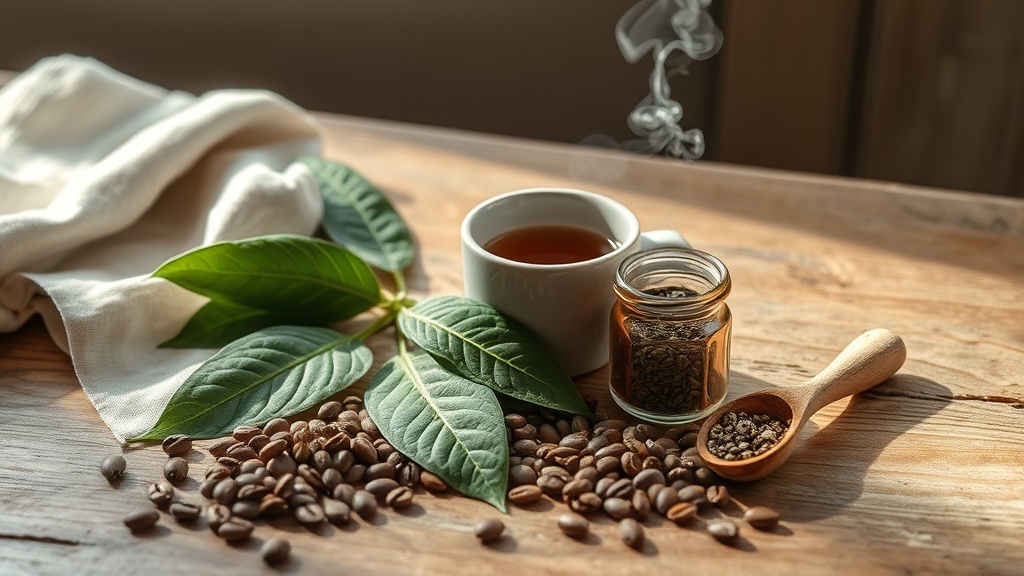
Kratom and coffee share more history than most people realize. Both come from the same plant family, both have been used for centuries to boost energy and endurance, and both are increasingly combined by people looking for a stronger jolt in the morning. But the resemblance stops at the family tree. Once you look at the chemistry, these two plants work through almost entirely separate systems in the body. This guide walks through where kratom and coffee overlap, where they diverge, what happens when people combine them, and how to think about timing and dosing if you decide to try it.
The Botanical Connection
Kratom (Mitragyna speciosa) and coffee (Coffea arabica) both belong to Rubiaceae, one of the largest flowering plant families on earth, with more than 13,000 species. That puts them in the same broad category as cousins, even though they split into separate genera long ago. Researchers have noted that Mitragyna sits alongside Coffea and Uncaria (cat’s claw) as one of several psychoactive genera within this family.
The shared ancestry shows up in a few visible traits: both plants grow in tropical and subtropical climates, both have broad, glossy leaves with prominent veins, and both store their active compounds in leaf tissue. That’s roughly where the similarities end. Coffee’s defining compound is caffeine, a methylxanthine. Kratom’s defining compound is mitragynine, a terpene indole alkaloid — a completely different class of molecule with a different mode of action in the brain.
It’s a bit like pointing out that roses and apples are both in the Rosaceae family. True, but it doesn’t mean they behave the same way once you get past the family label. Aspirin and digitalis both originate from plants too, and nobody would call them interchangeable.
Different Chemistry, Different Mechanisms
Caffeine’s mechanism has been studied extensively. It works as a non-selective antagonist at adenosine A1 and A2A receptors. Adenosine builds up in the brain throughout the day and contributes to feelings of tiredness; by blocking its receptors, caffeine reduces perceived fatigue and increases alertness, partly by boosting dopamine activity in reward pathways. Caffeine doesn’t meaningfully bind opioid, adrenergic, or serotonin receptors at normal doses.
Mitragynine is more complicated and its effects shift with dose. Research by Kruegel and Grundmann describes it as a partial agonist at mu-opioid receptors and an antagonist at kappa and delta receptors, with additional activity at alpha-2 adrenergic and serotonin (5-HT2A, 5-HT7) receptors. At lower doses, the adrenergic activity tends to dominate, producing stimulant-like effects — more energy, sharper focus, a mild lift in mood. At higher doses, the opioid activity takes over, leading to sedation and pain relief.
What this means practically: caffeine and mitragynine aren’t competing for the same targets in the brain. Any overlap in stimulant effects at low doses comes from two separate pathways working in parallel, not from one compound amplifying the other’s mechanism. Combine them, and you get an additive stimulant effect rather than true synergy at the receptor level.
Comparing the Two Compounds Side by Side
| Property | Caffeine (Coffee) | Mitragynine (Kratom) |
|---|---|---|
| Chemical class | Methylxanthine | Terpene indole alkaloid |
| Primary receptor targets | Adenosine A1, A2A (antagonist) | Mu-opioid (partial agonist), alpha-2 adrenergic, 5-HT2A |
| Onset (oral) | 15–45 minutes | 30–60 minutes |
| Peak plasma (oral) | About 1 hour | About 1.5 hours |
| Plasma half-life | 3–5 hours | About 9 hours |
| Dose-dependent shift | No — stimulant at all doses, anxiety at high doses | Yes — stimulant at low doses, sedating at high doses |
| Tolerance | Common with daily use | Common with daily use |
| Legal status (US) | Unscheduled, GRAS | Legal federally, varies by state |
The half-life gap matters more than people tend to expect. Caffeine clears the body in roughly 3 to 5 hours, while mitragynine sticks around for closer to 9 hours based on human pharmacokinetic data. A clinical study by Tanna and colleagues found that mitragynine reaches peak plasma concentration around 1.5 hours after ingestion and then tapers off gradually over the rest of the day. That means a morning kratom dose is still pharmacologically active well into the afternoon — long after that same morning’s coffee has left your system.
A Long Tradition of Combining the Two
Mixing kratom with caffeine isn’t a recent internet habit. It goes back to traditional use in Southeast Asia, where agricultural workers in Thailand chewed or brewed kratom leaves alongside other stimulants to get through long days of physical labor in hot conditions.
The clearest example is a Thai drink known as “4×100” — kratom leaf tea mixed with caffeinated soft drinks or energy beverages. A study by Wahbeh and colleagues analyzed a sample of this cocktail and found measurable amounts of both mitragynine and caffeine, along with codeine, chlorpheniramine, and phenylephrine. That confirms these multi-substance mixtures were actually used, not just discussed in theory.
Separate research by Singh and colleagues documented that kratom users in Malaysia and Thailand often combined the plant with other substances to change or intensify its effects, and caffeinated drinks were among the most common additions. This traditional use pattern supports the general safety of pairing kratom with caffeine at typical doses — though it’s worth noting the old cocktail recipes sometimes included pharmaceutical ingredients that have nothing to do with how kratom is used in the US today.
Why Kratom’s Dose Curve Changes the Picture
One of the most misunderstood parts of kratom pharmacology is its biphasic effect. Caffeine is a stimulant at nearly every dose, with anxiety and cardiovascular strain kicking in only at high amounts. Kratom behaves differently — it moves from stimulant to sedative as the dose climbs.
| Dose Range | Coffee/Caffeine Effects | Kratom Effects | Combined Effect |
|---|---|---|---|
| Low: 1 cup coffee / 1–3g kratom | Mild alertness, less fatigue | Energy, focus, slight mood lift | Additive alertness; generally well tolerated |
| Moderate: 2–3 cups / 3–5g kratom | Strong alertness, possible mild anxiety | Transition zone between stimulant and sedative | Higher risk of nausea, anxiety, faster heart rate |
| High: 4+ cups / 5g+ kratom | Anxiety, jitteriness, elevated blood pressure/heart rate | Sedation, nausea, dizziness likely | Unpredictable; best avoided |
A survey-based study by Smith and colleagues among regular US kratom users found that doses under 5 grams were most often linked to stimulant-type effects — energy, focus, sociability — while sedative and pain-relieving effects became more common above 5 grams. Earlier work by Grundmann reached a similar conclusion: most US kratom users take it at low to moderate doses specifically for energy and focus.
This matters when you’re thinking about coffee. If you’re taking a low kratom dose for its stimulant effect, adding coffee pushes in the same direction — but the dose of each substance still matters. If your kratom dose creeps into sedating territory while the coffee is still working, you end up with a mixed, uncomfortable experience instead of a clean combined effect.
What Actually Happens When You Combine Them
Because caffeine and mitragynine act on separate receptor systems, there’s no direct pharmacological interaction happening at the binding level — neither compound changes how the other attaches to its targets. Instead, what increases is the overall stimulant load on the body, and that’s where the noticeable effects come from.
Commonly reported effects among people who combine kratom and coffee:
- Sharper alertness and focus, especially when both are taken at low doses in the morning
- Faster heart rate — caffeine raises it through adenosine blockade and indirect adrenergic effects, and kratom’s own adrenergic activity can add to that at low doses
- Nausea, more likely if either is taken on an empty stomach, and more likely still when both are present
- Reduced appetite, since both compounds suppress hunger through different mechanisms that can stack
- Anxiety or jitteriness, which shows up at moderate-to-high doses of either substance and becomes more likely when combined, particularly for people sensitive to caffeine
In practice, this combination tends to work better for people who already have a modest caffeine tolerance, keep kratom in the 1–3 gram range, and eat something before taking either one. Problems tend to show up when someone adds kratom on top of several cups of coffee already in their system, or increases the kratom dose because they don’t feel it strongly enough over the caffeine.
Timing Kratom and Coffee Together
Because caffeine and mitragynine have different onset times and clear the body at different rates, timing changes the experience quite a bit.
| Timing Approach | Method | What to Expect | Best For |
|---|---|---|---|
| Simultaneous | Both taken at the same time | Coffee peaks first (~1hr), kratom follows (~1.5hr) — a slight stagger | Morning productivity window |
| Coffee first, kratom 30 minutes later | Coffee kicks in before the kratom dose | Both compounds peak close together | Maximum alertness, but manage the dose carefully |
| Kratom first, coffee 1–2 hours later | Kratom peaks, then coffee extends the window | Longer productive stretch, lower peak intensity | Extended work sessions |
| Alternating days | Kratom only on coffee-free days | Easier to judge each compound on its own | Beginners or anyone managing tolerance |
The key detail to keep in mind: with a roughly 9-hour half-life, an 8 a.m. kratom dose still has about half its peak concentration in your system by 5 p.m. Adding an afternoon coffee on top of that isn’t a clean, isolated caffeine dose — it’s caffeine layered onto kratom that’s still active. This matters most for sleep. Both substances at high doses can interfere with normal sleep patterns, and kratom’s long half-life means a mid-morning dose can still affect how well you sleep that night.
Things to Think About Before Combining Them
Caffeine sensitivity. People metabolize caffeine at very different rates depending on variation in the CYP1A2 enzyme. Slow metabolizers are more likely to feel anxiety, a racing heart, or disrupted sleep from any caffeine intake, kratom included. If coffee alone tends to make you anxious, adding kratom’s adrenergic effects — even at a low dose — will likely make that worse, not better.
Empty stomach versus food. Taking either substance on an empty stomach raises the risk of nausea and gastric irritation; combining both on an empty stomach compounds that risk. Eating something light beforehand generally improves how well you tolerate the combination, without significantly changing how either compound is absorbed.
Cardiovascular effects. Both caffeine and low-dose kratom can nudge heart rate and blood pressure up slightly. For most healthy adults at typical doses, this stays within a safe range. Anyone with an existing heart condition or elevated blood pressure should be more cautious and talk to a doctor before combining the two.
Hydration. Coffee has a mild diuretic effect, and kratom-related nausea can also reduce fluid intake, so dehydration is a real possibility with either. Drinking water before taking either substance is a simple habit worth keeping. No lab test can account for your personal hydration level — that part is on you.
Tolerance. Since caffeine and mitragynine don’t share receptor systems, building tolerance to one doesn’t directly transfer to the other. That said, both develop tolerance with regular daily use, and both benefit from occasional breaks to reset sensitivity.
Frequently Asked Questions
Are kratom and coffee from the same plant?
No. They’re in the same plant family, Rubiaceae, but they’re entirely separate species. Coffee comes from the genus Coffea, mainly Coffea arabica. Kratom comes from Mitragyna speciosa, a large tropical tree native to Southeast Asia. They share distant ancestry but diverged long ago and produce completely different classes of alkaloids. Think of it like roses and apples both belonging to the Rosaceae family — related, but very different plants in practice.
Does kratom contain caffeine?
No. Kratom doesn’t naturally contain caffeine. Caffeine comes from Coffea, Camellia (tea), and a handful of other plants. Kratom’s active compounds are terpene indole alkaloids, mainly mitragynine and 7-hydroxymitragynine. The only time kratom and caffeine show up together is when someone deliberately combines kratom with a caffeinated drink, as seen in the traditional Southeast Asian “4×100” mixture. A pure, lab-tested kratom product with no additives will test negative for caffeine.
Can I brew kratom and coffee together?
Yes, and some people prefer it that way. Kratom brews well in hot — not boiling — water, and a small amount of acid, like lemon juice, helps extract more mitragynine. Mixing kratom tea with coffee just combines two drinks; it doesn’t change the chemistry of either one. The main downside is that brewing them together makes it harder to control each dose separately. It’s usually easier to brew kratom tea on its own and mix it with coffee afterward, so you can adjust the amount of each independently.
Does coffee affect how kratom is absorbed?
There’s no published clinical evidence that caffeine directly changes how mitragynine is absorbed. Coffee can affect gastric pH and motility, which could theoretically have a small effect on absorption speed, but this hasn’t been directly studied. Separately, research by Tanna and colleagues found that eating food slows kratom absorption and lowers peak plasma concentration while extending the time it takes to reach that peak — so combining kratom and coffee with a meal would likely show a similar pattern. Both compounds are processed mainly through the CYP3A4 and CYP2D6 liver enzymes, and there’s no evidence of meaningful competition between them at normal doses.
Is kratom more like coffee or more like opioids?
At low doses, kratom’s effects lean closer to coffee — more energy, sharper focus, improved mood. At high doses, its opioid receptor activity takes over and produces sedation and pain relief more typical of opioids. The underlying mechanism is different from caffeine either way: kratom is a partial mu-opioid agonist with an unusual pharmacological profile, while caffeine has no opioid activity at all. Calling kratom “like coffee” is fair for low-dose effects, but it’s not the whole picture.
Will combining kratom and coffee cause anxiety?
It depends mostly on your caffeine sensitivity and the doses involved. Both caffeine at moderate-to-high amounts and low-dose kratom’s adrenergic activity can raise heart rate and contribute to anxious feelings. If you’re sensitive to caffeine, even small amounts of both together might cause jitteriness or racing thoughts. If your caffeine tolerance is decent and you keep both doses modest, anxiety is less of an issue. As a rule of thumb: if coffee alone reliably makes you anxious, adding kratom probably won’t fix that.
Can I use kratom instead of coffee?
Some people do swap their morning coffee for a low dose of kratom, especially if they want stimulant-like effects without caffeine’s jitteriness or sleep disruption. A 1–3 gram dose commonly produces energy and focus comparable to a cup of coffee. But kratom’s much longer half-life — about 9 hours versus roughly 5 for caffeine — means the timing works differently, since a morning dose can linger into the evening and potentially affect sleep. Kratom also isn’t classified as GRAS and carries different regulatory considerations than coffee. It’s a workable substitute for some people, not a direct one-to-one swap.
Does kratom interact with caffeine in dangerous ways?
At normal consumer doses, there’s no documented evidence of a dangerous interaction between the two. They act on separate receptor systems and don’t appear to interfere with each other’s metabolism at typical amounts. The main risk is simply an additive stimulant load — faster heart rate, more anxiety, nausea — particularly at higher doses of either or both. Anyone with heart issues, stimulant sensitivity, or who takes other adrenergic or cardiac medications should check with a healthcare provider first.
Which kratom strains pair best with coffee?
White and green vein strains are the ones most often paired with coffee, since their alkaloid profiles lean toward stimulant effects at low doses. Red vein strains, which tend toward relaxation and sedation, are less commonly combined with coffee — pairing a sedative strain with a stimulant drink often produces a muddled, uncomfortable feeling rather than a productive one.
How much kratom is safe to take with coffee?
There’s no established clinical guideline for a specific safe ceiling when combining the two. Based on general pharmacology and reports from experienced users, a reasonable approach is to keep kratom in the 1–3 gram range, limit coffee to 1–2 cups (roughly 100–200 mg of caffeine), eat something with both, and stay hydrated. These are conservative starting points meant to keep total stimulation manageable — individual tolerance varies a lot, so it’s worth starting low and paying attention to how you respond before increasing either one.
Is kratom tea with coffee the same as “kratom coffee”?
They’re essentially the same idea — combining brewed kratom with coffee. “Kratom coffee” sometimes means stirring kratom powder directly into brewed coffee, similar to a toss-and-wash method done in liquid form. “Kratom tea with coffee” usually means brewing kratom separately as a proper tea and then combining the two drinks. Either way, the alkaloid content and pharmacology are the same — the difference is just preparation and texture. Brewing kratom as a proper tea first, ideally with a bit of acid to aid extraction, tends to improve both taste and extraction compared to mixing raw powder into cold coffee.



[…] bitterness. Curious about other combinations? There’s also an interesting relationship between kratom and coffee worth looking […]