



Walmart doesn’t sell kratom. Neither does Target, Amazon, GNC, or Walgreens. If you’ve searched the aisles or checked their websites and come up empty, that’s not a stocking mistake — it’s a deliberate choice.
This isn’t about whether people want kratom. Estimates suggest more than 20 million Americans use it in some form. The real story is about regulation, liability, and the practical risks that keep it off the shelves of major chains.
Why Big Retailers Avoid It
The FDA has stated that kratom isn’t lawfully marketed in the U.S. as a drug, a dietary supplement, or a food additive. That single position is enough to scare off most large retailers before any other factor comes into play.
Walmart runs on scale, and every product category gets vetted by legal teams before it ever reaches a shelf. With no FDA approval — and after rejecting six separate new dietary ingredient applications from kratom companies — there’s simply too much legal ambiguity for a company that size to justify the risk.
There’s also a financial wrinkle most people don’t think about. Payment processors frequently flag kratom as “high-risk,” which makes setting up merchant accounts harder and adds friction to transactions. Between the regulatory gray zone and the banking headaches, it’s easier for Walmart to just skip the category entirely.
None of this means kratom has been proven dangerous. It means corporations avoid anything that could invite legal trouble or bad press while federal rules remain unsettled.
Where People Actually Find It
Kratom being absent from major retailers doesn’t mean it’s hard to find — it just tends to show up in less reliable places.
Gas stations, convenience stores, and smoke shops have filled that gap. But these outlets rarely follow the same quality controls that dedicated kratom vendors use. That gap in oversight has real consequences: nine people died after consuming a kratom product that had been laced with O-desmethyltramadol, a substance with opioid-like effects, sold through convenience store channels.
The core problem is testing — or the lack of it. Products sold outside specialty vendors often skip third-party lab verification entirely, so there’s no way to confirm purity, strength, or whether something else has been mixed in.
Contamination is more common than most buyers realize. Heavy metals, uneven alkaloid content, and synthetic additives have all turned up in products from suppliers without proper quality controls. The CDC identified kratom as a contributing factor in roughly 2,343 overdose deaths between 2020 and 2022 — though most of those cases involved multiple substances or adulterated products, not pure kratom on its own.
Where you buy matters. What you’re actually buying matters more.
A Better Route: Specialized Vendors
If quality and consistency matter to you, the smarter move is skipping convenience stores altogether and buying from vendors that focus specifically on kratom.
These companies treat lab testing as standard procedure, not an optional extra. Third-party verification confirms that what’s on the label matches what’s in the product, and many operate out of GMP-certified facilities — a level of process control convenience stores simply don’t have.
Sourcing also makes a real difference. Indonesia produces the vast majority of the world’s kratom supply — around 95% by most estimates. Vendors with direct relationships to Indonesian farms can offer fresher product and clearer traceability, while kratom sold through convenience channels often passes through several unknown middlemen first.
Buying direct also tends to mean better pricing, since specialty vendors aren’t paying retail markup. You also get access to people who actually understand kratom strains, vein colors, and alkaloid profiles — and customer support built around that knowledge rather than general retail training.
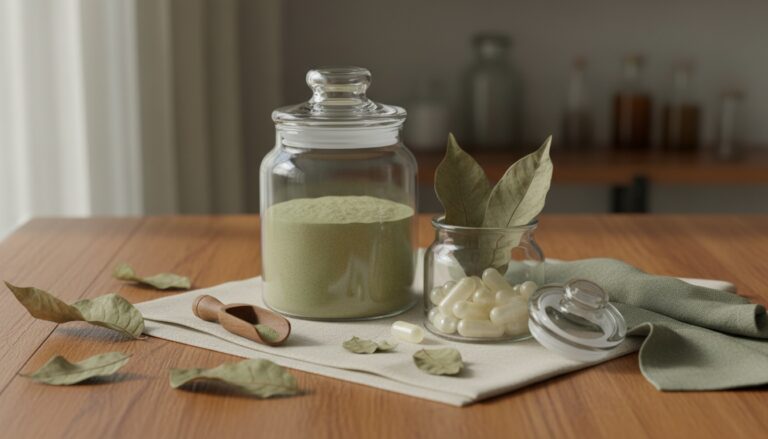
Whether your preference is traditional powder, capsules, or concentrated extracts, specialty vendors typically offer far more variety and far better quality control than anything you’d find at a gas station counter.
Could Walmart Eventually Sell Kratom?
It’s possible, but not soon.
The American Kratom Association has helped pass Kratom Consumer Protection Acts in 13 states as of 2025, and five of the six states that once banned kratom outright are now moving toward regulated frameworks instead of prohibition.
Age restrictions are also spreading. Eighteen states now require buyers to meet a minimum age, with Mississippi becoming the latest to set a 21-and-up rule in July 2025. These state-level moves suggest the broader trend is toward regulation, not bans.
At the federal level, the Federal Kratom Consumer Protection Act has been introduced in Congress. It hasn’t passed, but its introduction alone signals that kratom is being taken seriously in policy discussions.
The market keeps growing regardless. Mainstream retail sales of kratom hit $441.4 million through October 2024, up nearly 22% year-over-year, and some projections put the market at $7.80 billion by 2032.
Big retailers are almost certainly watching these numbers. But they’re unlikely to act until federal approval is clear-cut — and that’s likely years away, not months.
What About the Sketchy Convenience Store Products?
In July 2025, the FDA recommended scheduling synthetic 7-hydroxymitragynine (7-OH) — a concentrated kratom derivative some stores had marketed as “legal morphine.” Importantly, the agency specified that this action targets the synthetic compound, not natural kratom leaf or traditional ground kratom.
That distinction matters. The FDA’s concern is with altered, concentrated compounds being sold under kratom’s name — not with pure kratom from vendors who test what they sell. The American Kratom Association backed the move, noting that 7-OH products “are not kratom” but chemically modified substances with opioid-like effects.
If anything, this crackdown helps legitimate vendors by drawing a clearer line between tested, unaltered kratom and the synthetic products causing problems in convenience stores.
Knowing that difference is worth remembering before you buy.
The Bottom Line
Walmart isn’t selling kratom anytime soon. Regulatory uncertainty and corporate caution keep it off the shelves of every major retail chain, and that’s not likely to change in the near future.
That leaves buyers with two real choices: take a chance on untested convenience store products, or buy from vendors who actually test their kratom and understand the plant. For most people, that’s not really a close call.
Amazing Botanicals has focused on kratom since 2014, sourcing directly from Indonesian farms and lab-testing every batch. Products are processed in AKA GMP-qualified facilities, and the lineup includes powders, capsules, extracts, teas, and edibles for both new and experienced users.
Major retailers may eventually enter this market, but that’s a long-term prospect. Until then, buying from a specialized, quality-focused vendor remains the more reliable path.
Frequently Asked Questions
Can you buy kratom at Target or CVS?
No. Like Walmart, these retailers avoid kratom because of FDA restrictions and unresolved regulatory questions.
Is buying kratom online legal?
In most states, yes. Kratom is legal federally and in the majority of U.S. states, though some states and cities restrict or ban it, and others set age limits. Check your local laws before ordering.
Why is gas station kratom considered risky?
These products often lack third-party lab testing, so there’s no way to confirm purity or strength. Some have tested positive for synthetic additives, heavy metals, or inconsistent alkaloid levels.
How can I tell if a kratom vendor is trustworthy?
Look for third-party lab results, GMP-certified processing, direct sourcing from Indonesian farms, and transparency about their practices. Be cautious of vendors making unverified health claims or that can’t back up their quality standards.
Will Amazon start selling kratom?
Not likely soon. Amazon’s policies currently prohibit kratom sales for the same regulatory reasons that keep it off Walmart’s shelves, and that’s unlikely to shift without clearer FDA guidance.