



The kratom industry spent years dreading one word: ban. Indonesia grows nearly all the world’s kratom, so any move against it would ripple through every market that depends on the plant. In September 2024, the government finally acted. It didn’t ban kratom. It regulated it — and for anyone buying kratom today, that regulation is already shaping what’s on the shelf and what it costs.
Regulation Instead of Prohibition
The threat of a ban dates back to 2019, when Indonesia’s Ministry of Health floated a plan to phase out kratom entirely over five years. Farmers would have had to switch crops, exporters would have closed up shop, and the global supply chain would have scrambled to find a replacement source.
That proposal ran into serious opposition. Kratom farming supports roughly 200,000 households in West Kalimantan alone, and a ban would have hit rural communities hard. Advocacy groups, including the American Kratom Association, pushed back with economic data and safety arguments aimed at Indonesian officials.
By September 2024, the government had settled on a different path. Two ministerial regulations took effect on September 29, establishing rules for kratom exports while leaving domestic use untouched. The goal was to build a legal, traceable trade system rather than shut the industry down.
It’s a better outcome than a ban. But the new rules aren’t without teeth.
What the New Export Rules Require
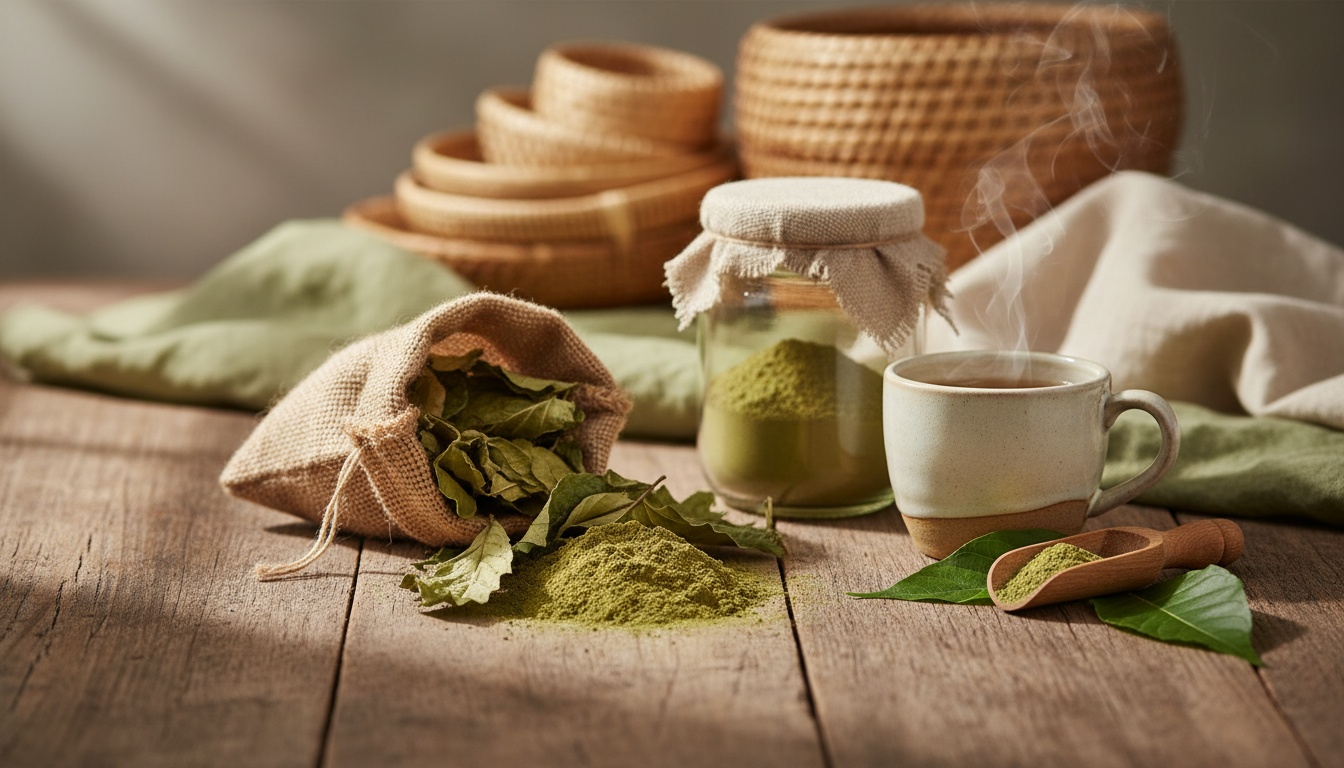
The regulations block the export of raw kratom leaves and coarse crumbs. From now on, only finely ground powder — with a maximum particle size of 600 microns — can legally leave Indonesia.
That single change reshaped the supply chain. Extract manufacturers had long relied on crushed leaf as their core raw material, and losing access to it hit them hardest. Powder suppliers had an easier adjustment, though everyone had to meet tougher quality benchmarks.
Every export shipment must now pass testing for heavy metals, microbial contamination, and adulteration, carried out by the Indonesian testing firm PT SUCOFINDO. Only 52 exporters currently hold authorization to ship kratom internationally under the new system. Indonesia also added a pre-export notification process, giving importing countries — the U.S., Germany, the Czech Republic, and others — advance documentation before shipments arrive.
The Global Kratom Coalition backed the framework in 2024, calling it a reasonable step toward better quality control and oversight.
The Rocky Rollout
Rules on paper are one thing. Getting them working in practice is another.
Once the regulations took effect, containers of kratom sat idle at Indonesian ports for months while exporters scrambled to meet the new testing and format requirements. The first cleared shipment didn’t move until late February 2025 — 351 tons across 13 containers, representing a massive backlog.
That delay created a real supply crunch. Crushed leaf prices jumped 100 to 400 percent compared with late 2024, depending on the strain and supplier. Extract makers took the hardest hit, since their entire production model depends on crushed leaf. Powder suppliers saw smaller price increases, though even they dealt with temporary shortages.
The effect on you as a buyer depends largely on what form of kratom you use.
Powder supply stabilized fairly quickly once the backlog cleared, with only modest price increases to cover higher compliance costs. If powder is your go-to, you’ve likely noticed small price bumps and occasional stock gaps, but nothing dramatic.
Extracts are a different story. Tablets, tinctures, and concentrates all rely on crushed leaf, which can no longer legally leave Indonesia. Some manufacturers built up stockpiles before the rules kicked in, but those supplies won’t last forever. Expect prices and availability for extracts to stay unpredictable well into 2025.
A Higher Quality Floor
Amid all the disruption, one upside stands out: quality standards across the board just went up.
Before these regulations, testing practices varied wildly from supplier to supplier. Some ran rigorous quality checks; others barely tested at all. Now every batch leaving Indonesia has to clear screening for contaminants and adulterants before it ships.
For companies that already prioritized lab testing and GMP certification, this simply confirms what they were doing all along. For suppliers who cut corners before, the new rules force a real change in practice.
The format restriction helps too. Finely ground powder is far easier to test consistently than irregular crushed leaf, so the 600-micron standard actually supports more reliable contamination screening.
Higher prices and fewer format choices are the cost. Better testing and lower contamination risk are the payoff.
What This Means for Your Next Purchase
If you buy powder, you’re in a relatively comfortable spot. Supply has mostly normalized, and price increases have been modest. Capsules, teas, and other powder-based products follow the same pattern.
If you rely on extracts, brace for more turbulence. Manufacturers are experimenting with powder-based extraction methods or looking to other sourcing countries, but that transition takes time. Expect prices and availability to keep shifting.
Crushed leaf is the format facing the steepest decline. Some suppliers still have pre-regulation stock, but once that runs out, Indonesian crushed leaf will become hard to find.
When picking a supplier, look for ones with a track record of third-party lab testing and GMP certification — they typically adjusted to the new rules faster. Be wary of suppliers who seem to be scrambling to meet requirements for the first time, since that often means more disruption on their end. Transparency about sourcing and testing practices is a good sign of a supplier that’s handling the transition well.
Could Other Countries Follow?
Indonesia’s approach may become a model for other kratom-producing nations. Thailand has already legalized kratom cultivation and export. Malaysia is grappling with its own regulatory questions. Smaller producers across Southeast Asia are watching closely to see how Indonesia’s system plays out.
If it proves workable — balancing quality control with economic reality — other countries may adopt similar rules. That would push the global kratom market toward more consistency, but likely at a higher baseline cost, since compliance isn’t free.
For buyers, that could mean steadier quality but less price fluctuation over time. For the industry, it could mean more legitimacy and less regulatory uncertainty hanging over every shipment.
Either way, the market isn’t going back to how it looked before September 2024. The shift in format, testing, and pricing appears to be permanent.
The Bottom Line
Indonesia chose regulation over prohibition, and that decision reshaped how kratom moves from farm to consumer. Mandatory testing offers real protection against contaminated product. Format restrictions cut off some options while improving consistency. Higher prices reflect both new compliance costs and short-term supply gaps.
Suppliers who were already operating at a high standard adapted the fastest. Buyers who understand what’s changed — and adjust their expectations around pricing and availability — will navigate this new landscape more easily than those caught off guard.
A proposed ban turned into a regulatory framework instead. That outcome kept the industry alive while raising the bar on quality. Whatever you buy next reflects that shift.
Frequently Asked Questions
Did Indonesia ban kratom exports?
No. Instead of a ban, Indonesia introduced export regulations in September 2024. Kratom can still leave the country, but only as finely ground powder that passes mandatory lab testing.
Why did kratom prices go up?
Prices rose because of port delays during the transition, new testing requirements, and the ban on crushed leaf exports. Powder saw modest increases; crushed leaf and extracts spiked 100–400%.
Can I still buy crushed leaf kratom?
For now, yes — through existing inventory. But Indonesia no longer exports it, so once current stock runs out, crushed leaf from Indonesian sources will become scarce.
Are these regulations good for consumers?
It’s mixed. Testing requirements improve safety and consistency, but format restrictions and compliance costs mean fewer options and higher prices in some categories.
Will other countries adopt similar rules?
Possibly. Thailand, Malaysia, and other producing countries are watching Indonesia’s system closely. If it works well, similar frameworks could spread across the region.