



Kratom, the tropical tree known scientifically as Mitragyna speciosa, has been part of daily life in parts of Southeast Asia for generations — probably long before anyone wrote it down. A Dutch botanist gave it a formal name in 1839. Thailand banned it in 1943, mostly to protect government opium revenue, not to protect public health. It didn’t show up in Western markets in any real quantity until the early 2000s. In 2016, the DEA tried to place kratom in the strictest drug category and backed down after an outpouring of public objection. By 2021, the World Health Organization had reviewed the evidence and recommended against international scheduling. Today, US regulation happens state by state, with more states adopting consumer protection laws modeled on legislation from the American Kratom Association.
None of this happened because of careful pharmacological study. Kratom’s path from a working plant used by farmers and laborers to a subject of federal drug hearings was shaped by colonial record-keeping, wartime economics, an opioid epidemic, and the internet. Knowing that backstory helps explain why kratom products, laws, and research look the way they do now.
Where kratom comes from and how it was traditionally used
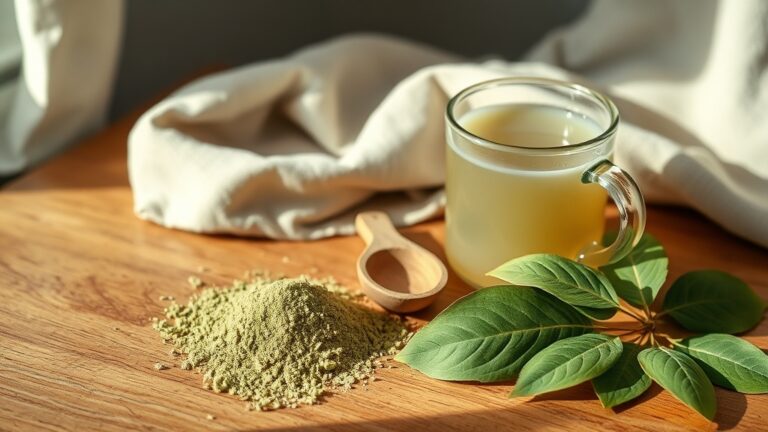
Mitragyna speciosa is an evergreen tree in the coffee family, native to Thailand, Malaysia, and parts of Indonesia, including Borneo and Sumatra. It grows wild in humid lowland forest and along riverbanks, usually below 500 meters in elevation.
For generations, people used it simply: fresh leaves chewed on the spot or brewed into a plain tea. Farmers and laborers in Thailand and Malaysia relied on it to get through long, physically demanding days — pushing back fatigue, easing soreness, keeping going. In some communities it also had a social role, offered to visitors as a gesture of hospitality, in much the way betel nut is used elsewhere in the region.
Traditional use looked quite different from how kratom is consumed today:
- Only fresh whole leaf — no powders, extracts, or concentrated products
- No standard dosing — people judged amounts based on experience, not measurement
- No strain names — labels like Maeng Da, Bali, or Borneo didn’t exist; those are modern marketing terms
- Not seen as a drug or supplement — it was simply an everyday plant, woven into daily routines
- Practices varied by region — Thai, Malaysian, and Indonesian communities didn’t all use it the same way
When Western science first took notice
Kratom entered the scientific record in 1839, when Dutch botanist Pieter Willem Korthals described and named the species while working in Borneo for the East India Company. He originally called it Stephegyne speciosa. A British botanist, George Daniel Haviland, reclassified it under the genus Mitragyna in the 1850s, grouping it with related plants based on shared physical traits — the name refers to the mitre-shaped flower parts.
Early European accounts of kratom were written through a colonial, administrative lens. Botanists were cataloguing plants of economic interest, noting local uses in passing, and slotting the species into existing classification systems. The deeper cultural picture — how kratom fit into labor, social life, and folk medicine — often got flattened or filtered through outsider assumptions.
The chemistry took much longer to catch up. Researchers isolated the first known kratom alkaloid in 1921, later named mitragynine. More thorough chemical analysis followed between the 1960s and 1980s as lab methods improved. The compound 7-hydroxymitragynine, which turns out to bind opioid receptors more strongly than mitragynine itself, wasn’t fully identified until the 1990s.
Why Thailand banned kratom in 1943
Thailand’s Kratom Act (officially the Kratom Act, B.E. 2486) passed in 1943 under Prime Minister Phibun Songkhram. To understand why, it helps to look at wartime drug economics rather than public health policy.
At the time, Thailand ran a legal, government-controlled opium trade, and taxing that trade brought in significant revenue. Kratom offered rural users some of the same practical benefits as opium — pain relief, help getting through withdrawal-related fatigue — but for free. That made it a direct threat to the state’s opium income. Records from parliamentary discussions at the time openly note that cutting kratom use would push more money toward the opium and heroin trade.
In other words, the ban wasn’t about protecting anyone from harm. It was a revenue-protection measure, and that same pattern — economics driving policy more than science — would repeat itself in other countries decades later. Enforcement in Thailand, for what it’s worth, stayed spotty for most of the rest of the century.
Other countries in the region took their own paths. Malaysia restricted mitragynine under its 1976 Poisons Act. Indonesia, now the world’s largest kratom exporter, has kept a murky, inconsistent regulatory stance. Thailand itself eventually reversed course: in 2021 it decriminalized kratom and dropped it from its narcotics list, openly acknowledging its economic and cultural value.
How kratom reached Western markets
Kratom didn’t travel to the West through old trade routes — it arrived through the internet. The first real Western exposure started in the late 1990s and early 2000s, driven largely by:
- Online ethnobotanical sellers — niche websites offering unusual plant products to hobbyists and researchers
- Early online communities — sites like Erowid and Bluelight, and later Reddit, where users swapped firsthand accounts
- Harm reduction circles — people managing opioid withdrawal began discussing kratom as a self-directed aid
- A handful of academic researchers — pharmacologists who started examining kratom’s alkaloids and receptor activity in the early 2000s
During this stretch, kratom sat in a legal gray area across most Western countries — unregulated, mostly unknown, and sold in inconsistent forms with no quality standards or testing.
The opioid crisis in the US, which worsened through the late 2000s and 2010s, gave kratom’s Western growth a real push. People trying to cut back on or quit opioids increasingly reported using kratom on their own to manage symptoms — a pattern captured in several surveys, including a 2007 clinical report by Boyer and colleagues, one of the earliest Western medical accounts of kratom being used this way.
How the modern kratom industry took shape
US commercialization of kratom accelerated through the 2010s, growing from a small ethnobotanical niche into a real consumer product category. That growth brought:
- Wider retail access — kratom moved beyond online sales into gas stations, smoke shops, and specialty retailers
- More product formats — beyond raw powder and capsules came liquid shots, tablets, gummies, and standardized extracts
- Strain branding — names like Maeng Da, Red Bali, and Green Malay were created by vendors as marketing labels, not based on any real botanical distinction
- Industry self-policing — the American Kratom Association, founded in 2014, built a Good Manufacturing Practice certification that became the closest thing the industry has to a quality benchmark
Key dates in modern kratom history
| Year | Event |
|---|---|
| 1839 | Korthals formally describes Mitragyna speciosa |
| 1943 | Thailand bans kratom (Kratom Act B.E. 2486) |
| 2007 | Boyer et al. publish an early Western case report on kratom and opioid withdrawal |
| 2012 | FDA begins seizing kratom shipments — first major US regulatory action |
| 2014 | American Kratom Association founded |
| 2016 | DEA announces plan to emergency-schedule kratom as Schedule I, then withdraws it after 51 days |
| 2018 | AKA launches GMP program; FDA issues a public warning on kratom |
| 2021 | WHO’s ECDD recommends against international scheduling; Thailand decriminalizes kratom |
| 2022–2024 | Several US states pass Kratom Consumer Protection Acts; FDA review continues |
Where US regulation stands now
US kratom policy has followed a recurring pattern: an agency tries to restrict it, and pushback follows — from the public, Congress, or international bodies.
Kratom rules by state
| Approach | Example states | Typical rules |
|---|---|---|
| Consumer Protection Act adopted | Georgia, Utah, Arizona, Oklahoma, Nevada, Colorado, Virginia, West Virginia, Wyoming, New Hampshire | Minimum age 21, required lab testing, accurate labeling, no adulteration |
| Statewide ban | Alabama, Arkansas, Indiana, Rhode Island, Vermont, Wisconsin | Possession and/or sale prohibited, penalties vary |
| No state law | Most other states | Legal under federal law; local rules may still apply; no age or testing mandates |
| Local bans | Sarasota FL, San Diego CA, Jerseyville IL, among others | City or county restrictions within states that otherwise allow it |
FDA import alerts, 2012 to now
Starting in 2012, the FDA began seizing kratom shipments at the border, arguing it was being marketed as an unapproved drug. That action didn’t change the legal status of kratom already sold domestically, but it disrupted supply chains and signaled the agency’s ongoing opposition to the product.
The 2016 DEA reversal
In August 2016, the DEA announced it planned to emergency-schedule mitragynine and 7-hydroxymitragynine as Schedule I substances — the same category as heroin, meaning officially “no accepted medical use.” The backlash was immediate and large: more than 50 members of Congress signed bipartisan letters of objection, roughly 140,000 public comments poured in, and kratom users and researchers organized in protest. Fifty-one days later, the DEA withdrew the notice — the first time in the agency’s history that public pressure had reversed an emergency scheduling decision.
The WHO’s 2021 review
In 2021, the World Health Organization’s Expert Committee on Drug Dependence completed a formal review of kratom and recommended against scheduling it under international drug treaties, concluding the evidence of harm wasn’t strong enough to justify it. That decision mattered because it removed one of the main pressures that could have pushed the US toward federal scheduling.
State-level consumer protection laws
With no federal action forthcoming, the American Kratom Association has focused on state legislatures, pushing model Kratom Consumer Protection Acts that set age limits (usually 21+), labeling rules, and testing requirements — without banning the product outright. By 2024, a number of states had passed some version of this law, while a handful of states and cities chose outright bans instead. Estimates put the US kratom-using population somewhere between 10 and 15 million adults, a number large enough to make the case for clearer, more consistent regulation.
Why this history explains today’s confusing market
A lot of what seems odd about kratom today makes more sense once you know the backstory:
- Strain names aren’t real botanical categories. “Maeng Da,” “Bali,” and “Borneo” are marketing terms invented by sellers, not scientifically defined varieties.
- No FDA approval exists for kratom, for anything. It has never gone through the FDA’s drug approval process, and its status as a dietary supplement remains disputed — it sits in a regulatory gray zone.
- Product quality varies a lot. Fast commercial growth without a regulatory framework produced a market where quality differs wildly between brands. AKA’s GMP certification is the best available quality signal, but it’s voluntary, not government-required.
- Research is thin and recent. Most clinical work on kratom dates from after 2015. Without FDA approval, no drug company has funded large clinical trials, so what exists is mostly surveys, case reports, animal studies, and a handful of studies on how the body processes it.
- Public debate tends to be polarized. With the FDA taking an adversarial stance and a large, vocal community of users pushing back, measured, evidence-based conversation about kratom can be hard to find.
Frequently Asked Questions
How long has kratom been used?
Written records go back to at least 1839, but traditional use in Southeast Asia almost certainly predates that by a long stretch — likely centuries. The plant was woven into the daily lives and labor routines of rural communities in Thailand, Malaysia, and Indonesia well before Western science gave it a name.
Why did Thailand ban kratom?
The 1943 ban was mainly about money, not health. Kratom gave rural workers a free alternative to the government’s taxed opium supply for managing fatigue and pain, cutting into state revenue. Parliamentary records from the time make clear that officials expected the ban to boost opium income — there’s no indication it was based on evidence of harm.
When did kratom become popular in the US?
It first reached Western online communities in the late 1990s and early 2000s through niche botanical sellers and harm reduction forums. Growth picked up substantially through the 2010s, fueled by the opioid crisis and rising awareness of plant-based alternatives. By the mid-2010s, thousands of retailers and online vendors across most US states were selling it.
What happened with the DEA’s 2016 attempt to ban kratom?
The DEA announced in August 2016 that it would emergency-schedule kratom’s main compounds as Schedule I substances. The response was fast and forceful — over 140,000 public comments, bipartisan pressure from Congress, and organized advocacy from users. Fifty-one days later, the DEA backed off, the only time in its history a scheduling notice was withdrawn because of public opposition.
Is kratom legal in the United States?
Yes, at the federal level — it’s not a controlled substance under US law. But legality varies by state and even by city. A few states and municipalities ban it outright, while a growing number have passed consumer protection laws that regulate rather than prohibit it.
What is the American Kratom Association?
It’s an advocacy and industry group founded in 2014. It created the Good Manufacturing Practice certification, a voluntary quality standard covering testing, labeling, and manufacturing for kratom vendors. It’s also behind the model Kratom Consumer Protection Act that multiple states have since adopted.
What did the WHO say about kratom in 2021?
The WHO’s Expert Committee on Drug Dependence reviewed kratom in 2021 and recommended against listing it under international drug conventions, citing insufficient evidence of public health risk. That decision removed a major source of pressure that could have pushed the US toward federal scheduling.
What are kratom strain names and where did they come from?
Names like Maeng Da, Bali, Borneo, Green Malay, and Red Hulu are marketing categories created by vendors starting in the 2000s and 2010s, not botanical subspecies or scientifically verified classifications. They reflect branding decisions more than any consistent difference in alkaloid content, and none of them correspond to a regulated or standardized specification.